What Is a CMOS Image Sensor? Features, Applications, and Future Trends

-
home -
News & Events
News & Events -
What Is a CMOS Image Sensor? Features, Applications, and Future Trends
What Is a CMOS Image Sensor? Features, Applications, and Future Trends
What Is a CMOS Image Sensor? Features, Applications, and Future Trends
CMOS Image Sensor has become the backbone of modern camera systems, powering everything from autonomous vehicles to advanced robotics and vision-based automation. As vision systems demand faster processing, lower power consumption, and greater reliability, CMOS cameras have continued to evolve to meet these challenges.
So what makes CMOS cameras the standard choice for today's vision applications? In this article, we explore the fundamentals of CMOS image sensors and CMOS cameras, highlight their key characteristics, and examine why they play a critical role in modern vision systems and real-world use cases.
What Is a CMOS Image Sensor?
A CMOS image sensor is a digital chip that captures light and converts it into digital signals using CMOS (Complementary Metal-Oxide-Semiconductor) technology. It consists of a grid of pixels, each with a photodiode and on-chip circuitry for signal amplification and readout. This integration enables faster readout, lower power consumption, and compact sensor designs.
CMOS image sensors are widely adopted in modern cameras because they can support various configurations, including rolling shutters, global shutters, low-light, and high dynamic range (HDR) sensors. Their efficiency and versatility make them suitable for applications in automotive systems, autonomous robotics, and embedded Vision AI.
Leading CMOS sensors are produced by companies such as Sony, Onsemi, and OmniVision, providing the foundational technology that allows camera systems to deliver high-quality imaging across diverse environments.
What Is a CMOS Camera?
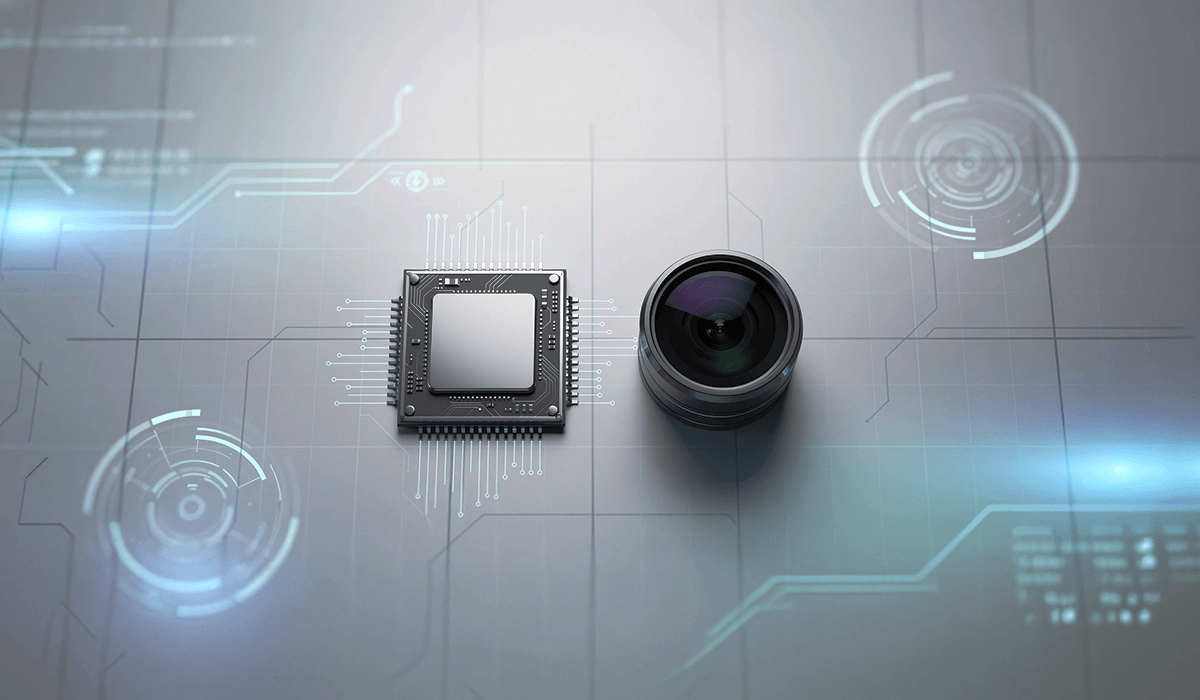
A CMOS camera is module built around a CMOS image sensor. Beyond the sensor itself, it includes the lens, image signal processor (ISP), and interface circuitry, working together to capture, process, and transmit images efficiently.
CMOS cameras leverage the advantages of the underlying sensors energy efficiency, fast image processing, and cost-effectiveness while providing real-time imaging capabilities.
Key Characteristics of CMOS Cameras
Building on the understanding of CMOS cameras, it’s important to highlight five key characteristics that define their performance in real-world applications like automotive, robotics, and Vision AI.
1. High Dynamic Range (HDR)
CMOS cameras capture details in both bright and dark areas, making them reliable in challenging lighting conditions like tunnels, shadows, or direct sunlight. HDR ensures critical details are preserved, improving perception and safety.
Read more: What is High Dynamic Range? Why is It Important for Automotive Cameras?
2. High Sensitivity and Low-Light Performance
High sensitivity allows cameras to function well in low-light environments, while low noise ensures clear and accurate images. Together, these features support reliable vision in diverse lighting scenarios.
3. High Resolution
High-resolution CMOS cameras deliver sharp, detailed images, enabling precise object detection, lane recognition, and industrial inspections. Higher resolution extends detection range and improves small object classification, enhancing algorithm performance and decision-making in autonomous systems.
4. Energy Efficiency
CMOS cameras consume less power than CCD-based cameras, which is vital for battery-powered and embedded systems. Lower energy use also reduces heat, contributing to system reliability.
5. High-Speed Imaging
Fast readout and high frame rates enable real-time imaging, allowing autonomous vehicles and autonomous robots to perceive and react quickly. On-camera processing further reduces latency, ensuring responsive operation.
What's the Difference Between CMOS and CCD?
CMOS and CCD are two widely used image sensor technologies that both convert light into electrical signals, but they differ in how image data is read and processed. CCD sensors move electrical charges across the chip to a single output node, resulting in sequential readout. CMOS sensors, in contrast, process signals directly at each pixel, enabling parallel readout, faster image processing, and lower power consumption.
In the past, CCD sensors were known for lower noise and better image uniformity, while CMOS sensors were favored for cost efficiency and power savings. Advances in semiconductor manufacturing have since improved CMOS performance, delivering high resolution, HDR, and low-noise imaging while maintaining advantages in speed, energy efficiency, and system integration. Today, CMOS sensors dominate most camera applications, while CCDs are mainly used in niche scenarios requiring extreme sensitivity.
| Category | CCD | CMOS |
| Pixel Readout Principle | Charge is transferred across the chip to a common output node | Charge is converted to voltage at the pixel or column level |
| Readout Architecture | Serial readout | Parallel readout |
| On-Chip Integration | Limited integration | High integration (ADC, ISP, HDR logic on-chip) |
| Image Quality | Historically high uniformity and low noise | High to very high with modern pixel architectures |
| Dynamic Range | High | Moderate to high |
| Frame Rate | Moderate | High |
| Noise Performance | Low fixed-pattern noise | Significantly improved |
| Power Consumption | Moderate to high | Low |
| Cost Scalability | Higher, limited scalability | Lower at volume, excellent scalability |
Why Is CMOS Camera Important for Vision Systems?
Vision systems rely on cameras not only to capture images, but to deliver reliable, real-time visual data for analysis, decision-making, and automation. In applications such as autonomous vehicles, autonomous robotics, and AI-based inspection, cameras must operate continuously, process large amounts of visual information, and adapt to changing environments. CMOS cameras meet these demands by combining speed, efficiency, and system-level integration.
Unlike traditional sensor architectures, CMOS cameras support real-time image capture and processing while maintaining low power consumption, making them suitable for embedded and edge-based vision systems. Their ability to integrate signal processing on-chip also reduces system complexity and latency, which is critical for tasks like object detection, navigation, and scene understanding. As vision systems continue to move toward higher autonomy and intelligence, CMOS cameras have become a foundational component that enables scalable, high-performance visual perception.
Applications of CMOS Cameras
CMOS cameras are widely used across modern vision systems, especially in applications that require real-time perception, reliability, and operation in dynamic environments.
Autonomous Trucks & Robotaxis
In autonomous driving, CMOS cameras enable real-time detection of lanes, vehicles, pedestrians, and traffic signals. Their ability to handle varying lighting conditions and high-speed imaging is critical for safe and accurate navigation.
Delivery Robots
Delivery robots rely on CMOS cameras for obstacle detection, localization, and navigation in both indoor and outdoor environments. Low power consumption and fast processing make CMOS cameras suitable for long operating hours.
Construction & Mining Vehicles
In construction and mining, vision systems must operate in harsh conditions such as dust, vibration, and extreme lighting. CMOS cameras provide robust visual input for object detection, safety monitoring, and autonomous operation.
Agricultural & Farming Robots
Agricultural robots use CMOS cameras for crop monitoring, navigation, and automated harvesting. High resolution and sensitivity allow accurate perception under changing weather and lighting conditions.
Humanoid & Quadruped Robots
Humanoid and quadruped robots depend on CMOS cameras for spatial awareness, balance, and interaction with their surroundings. High-speed imaging and low latency support real-time movement and decision-making.
How oToBrite Leverages CMOS Sensors in Its Camera Solutions
oToBrite designs its camera solutions around advanced CMOS image sensor technologies, integrating the latest sensors from leading manufacturers such as Sony and onsemi. This provides access to key sensor capabilities including high resolution, HDR, rolling shutter, global shutter, and low-light performance.
Beyond sensor selection, oToBrite focuses on image tuning and ISP-level optimization, refining exposure, noise reduction, and color performance to meet specific application requirements. The company also emphasizes camera system integration, optimizing data interfaces, signal stability, and latency to support real-time vision systems. By combining CMOS sensor capabilities with system-level expertise, oToBrite delivers reliable camera solutions for automotive and Vision AI applications.
Explore oToBrite CMOS camera system: https://www.otobrite.com/product-selector
The Future of CMOS Image Sensors from a Camera Maker's Perspective
Advances in semiconductor manufacturing are enabling smaller feature sizes, allowing more pixels in compact CMOS sensors for higher resolution without increasing camera size. For camera makers like oToBrite, this means the ability to design smarter, faster cameras that handle real-time processing and high-speed capture, essential for autonomous vehicles, robotics, and industrial vision systems.
On-chip digital processing continues to improve, supporting HDR, noise reduction, and AI-assisted image enhancement directly on the sensor. Combined with innovations in adaptive imaging, multi-camera synchronization, and high-speed data interfaces like SerDes, these developments allow manufacturers to deliver intelligent, reliable, and high-performance camera systems tailored to the complex requirements of modern Vision AI applications.