What is IP Rating? Why IP69K is a Must-Have for Outdoor Mobile Robots and Autonomous Vehicles

-
home -
News & Events
News & Events -
What is IP Rating? Why IP69K is a Must-Have for Outdoor Mobile Robots and Autonomous Vehicles
What is IP Rating? Why IP69K is a Must-Have for Outdoor Mobile Robots and Autonomous Vehicles
What is IP Rating? Why IP69K is a Must-Have for Outdoor Mobile Robots and Autonomous Vehicles
In outdoor mobile robotics and autonomous vehicle development, one of the most expensive mistakes is choosing a camera that can't survive harsh environments.
A camera that fails after pressure washing.
A camera that lets in dust and causes downtime.
These two failures trace back to one thing: insufficient IP protection.
If you're selecting cameras for your outdoor mobile robotics, autonomous vehicles, or any type of unmanned vehicles, understanding the difference between IP67 and IP69K, why it matters for your deployment is not only about getting technical knowledge. It’s a decision that directly impacts reliability, safety, and long-term cost. This article will help you understand IP ratings clearly, compare the two most common standards, and show how oToBrite validates true IP69K performance for real-world environments.
What is an IP Rating?
When you see a camera labeled as IP67 or IP69K, the “IP” simply means Ingress Protection. In other words, it tells you how well the device can keep dust and water out. Because outdoor robots and vehicles work in rain, mud, humidity, and dust, the IP rating is one of the easiest ways to understand whether a camera is ready for those conditions.
An IP rating has two digits. The first digit describes how protected the device is from solid particles like dust or sand. The second digit describes how well it can handle water whether it’s rain, puddles, splashes, or even high-pressure cleaning.
So instead of guessing whether a camera is “waterproof” or “dustproof,” the IP rating gives you a clear, standard way to know what level of protection you’re getting. It helps you choose a camera that won’t let water inside and won’t fail when the environment gets rough.
IP Ratings Chart
| Protection Against Dust | First Digit | Second Digit | Protection Against Water |
| No protection | 0 | 0 | No protection |
| Protected from large objects (>50 mm) | 1 | 1 | Protected from vertical dripping water |
| Protected from fingers or similar objects (>12.5 mm) | 2 | 2 | Protected from dripping water when tilted up to 15° |
| Protected from tools or wires (>2.5 mm) | 3 | 3 | Protected from spraying water up to 60° angle |
| Protected from most small objects (>1 mm) | 4 | 4 | Protected from splashing water from any direction |
| Some dust may enter, but won’t affect operation | 5 | 5 | Protected from low-pressure water jets from any direction |
| Completely dust-tight | 6 | 6 | Protected from high-pressure water jets |
| 7 | Protected from temporary immersion (up to 1M, 30 min) | ||
| 8 | Protected from continuous immersion in water | ||
| 9 | Protected from high-pressure, high-temperature water jets |
What Is The Difference Between IP67 and IP69K?
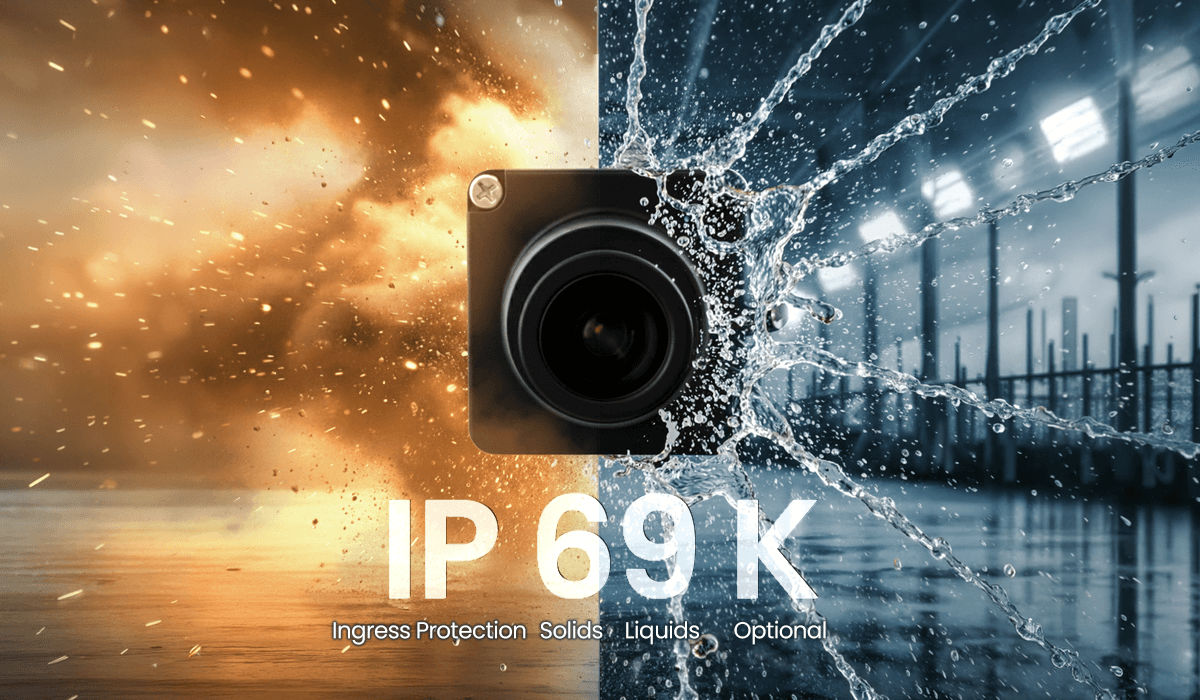
IP67 and IP69K are two of the most common ratings you’ll see on outdoor mobile robotics and automotive cameras. Both protect against dust and water, but they are designed for different types of challenges.
- IP67 cameras are dust-tight and can handle temporary immersion in water, like puddles, rain, or short accidental drops into water up to about 1 meter deep. In other words, IP67 cameras are waterproof for short periods and shallow water, but they are not meant for high-pressure cleaning or long-term submersion.
- IP69K cameras are also dust-tight, but they go a step further. They are designed to survive high-pressure, high-temperature washdowns, which are common in applications such as heavy-duty vehicles, construction and mining equipment, agriculture robots and robotaxi. While IP69K cameras are not typically meant to be continuously submerged like an IP68-rated device, they can handle powerful jets of water at close range without letting water in, which makes them ideal for tough cleaning and harsh outdoor environments.
In short, the difference is about how the camera handles water:
- IP67 = safe from rain, puddles, and short immersion
- IP69K = safe from high-pressure water jets and high-temperature water cleaning
For outdoor mobile robotics and autonomous vehicles that work outdoors or in tough environments, this distinction matters a lot. A camera rated only IP67 may fail if it’s cleaned with a high-pressure hose or works in environments where water jets are used. IP69K cameras, on the other hand, are built to handle aggressive high-pressure cleaning, giving you extra reliability in harsh conditions.
Why IP68 Is Less Common Than IP67 and IP69K for Cameras?
You might have seen IP68 on smartphones and wondered why it’s not widely used for robotics or vehicle cameras. The reason is simple: IP68 focuses on continuous water immersion, usually at a specified depth for an extended period. This makes sense for consumer electronics, but not for cameras.
Cameras on mobile robots, autonomous vehicles, and heavy machinery face dust, mud, rain, vibration, and high-pressure cleaning far more often than they face long-term underwater use. Because of this, designing a camera for IP68 adds extra cost and complexity without offering meaningful advantages for real-world operation.
How oToBrite Defines Real IP69K?
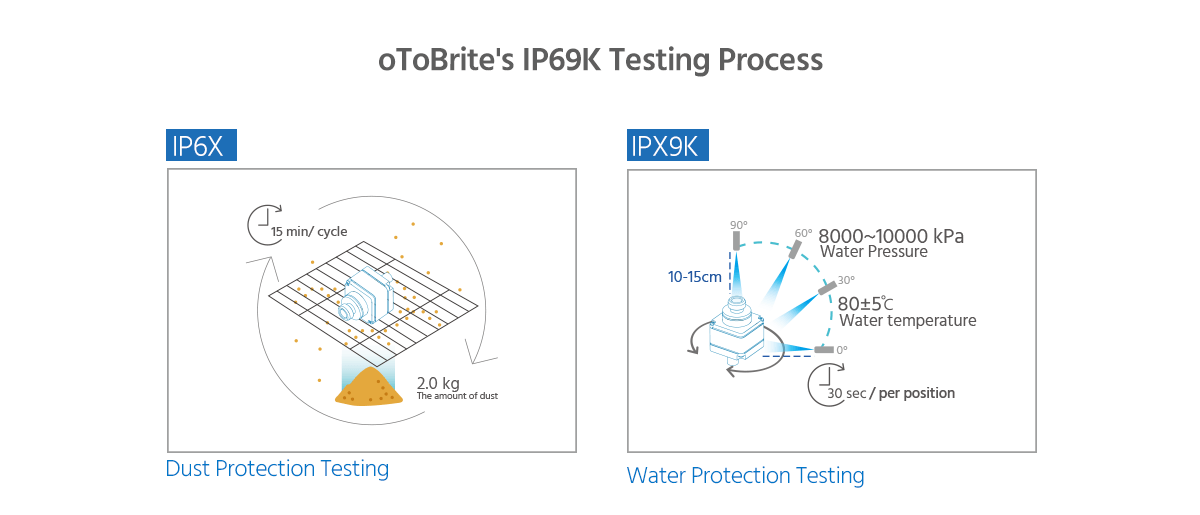
Not all “IP69K” labels in the market are the same. Some cameras on the market claim IP69K but are tested with less stringent conditions, which may not reflect the challenges of real-world applications. At oToBrite, we follow a strict validation process of ISO20653 to ensure our cameras truly withstand harsh environments, not just pass a minimal lab test.
1. IP6X (Protection Against Dust)
To confirm the camera is fully dust-tight, we run 20 cycles of dust testing (5 hours total) using 2 kg of fine dust. This simulates real outdoor conditions with constant exposure to dust, sand, and dirt. By the end of the test, the sensor, lens, and housing must remain completely dust-free.
2. IPX9K (Protection Against Water)
For water protection, we push the limits even harder:
- High-pressure jets: 8,000–10,000 kPa
- High temperature: 75–85°C
- Spray angles: 0°, 30°, 60°, 90°
- Spray distance: 10–15 cm
- Duration: 30 seconds per angle
This combination of heat, pressure, and close-range spray simulates real washdowns used on autonomous robotics and vehicles for agricultural, mining, and construction applications. Only cameras that pass all these tests without water or dust ingress and continue to function normally meet our definition of true IP69K.
By following these rigorous standards, oToBrite ensures that our cameras deliver reliable, long-term performance in the field, not just on a specification sheet.
Conclusion
IP ratings are more than technical numbers, they define how well cameras can withstand real-world conditions. For the applications like heavy-duty vehicles, construction and mining equipment, agriculture robots and robotaxi, IP67 is the minimum requirement for reliable operation in harsh environments, while IP69K is the best choice for those applications. IP69K ensures greater durability, safety, and operational efficiency in tough conditions.
However, it’s important to remember that not all IP ratings are created equal, the way each camera manufacturer achieves IP67 or IP69K can significantly affect the camera’s real-world performance.
If you want a camera system you can truly trust for autonomous vehicles or outdoor mobile robotics, explore our IP69K camera lineup and see how oToBrite can help your projects withstand the elements without compromise.
Explore oToBrite IP67/IP69K Cameras
FAQs
What does IP rating mean?
IP stands for Ingress Protection. It shows how well a device is protected from dust and water.
What do the two digits mean in IP codes?
The first digit shows protection against dust. The second digit shows protection against water.
What is IP67 rating?
IP67 means the device is dust-tight and can survive temporary immersion in water up to 1 meter for 30 minutes.
What is IP69K rating?
IP69K means the device is dust-tight and can withstand high-pressure, high-temperature water jets from close range.
Is IP67 waterproof?
IP67 is water-resistant and can handle rain, puddles, and short immersion, but it’s not designed for high-pressure cleaning.
Is IP69K waterproof?
IP69K protects against high-pressure water jets, but it’s not meant for long-term underwater use like IP68.
What IP rating is fully waterproof?
Ratings like IP68 indicate protection for continuous immersion in water, making them fully waterproof for most applications.
Are all IP69K cameras tested the same way?
No, testing standards can vary between manufacturers. Some may use less strict conditions, so real-world performance can differ.
Does IP rating affect camera image quality?
A properly designed IP-rated camera should maintain image quality, but cheaper designs with poor sealing can sometimes reduce clarity.
Which IP rating is suitable for outdoor mobile robots and autonomous vehicles?
IP67 works for moderate dust and rain, while IP69K is recommended for harsh conditions, high-pressure washdowns, and extreme outdoor environments.