ToF vs Stereo Camera for Outdoor Robots: How to Choose

-
home -
News & Events
News & Events -
ToF vs Stereo Camera for Outdoor Robots: How to Choose
ToF vs Stereo Camera for Outdoor Robots: How to Choose
ToF vs Stereo Camera for Outdoor Robots: How to Choose
Key takeaways
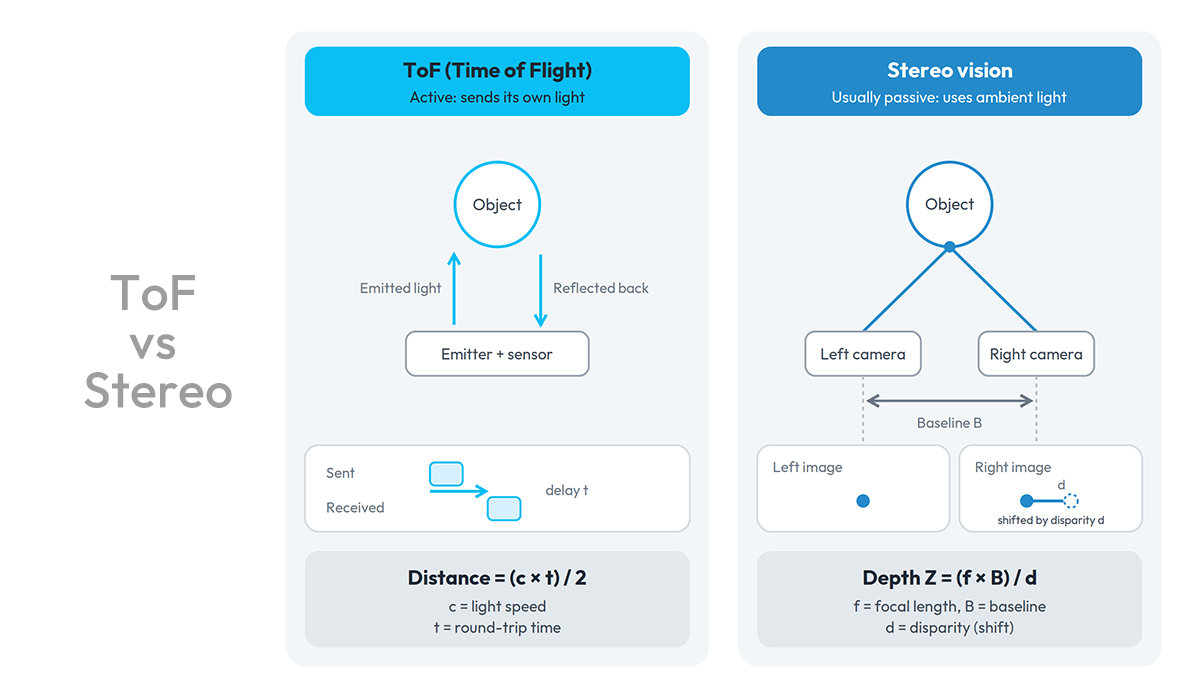
- A ToF (time-of-flight) camera measures how long its own infrared light takes to return. A stereo camera calculates depth from the disparity between two images.
- For outdoor robots, stereo is often a better fit for longer-range perception. It works from ambient light, while direct sunlight can reduce the effective range and accuracy of some ToF systems.
- ToF is strong at short range, especially for applications involving nearby objects, relatively plain surfaces, or limited computing resources.
- Some outdoor robots use both technologies, with ToF providing near-field depth and stereo supporting longer-range perception.
An outdoor robot has a harder job than an indoor one. A delivery robot crosses sidewalks in bright sunlight and long shadows. An autonomous mobile robot (AMR) may work across a port or logistics yard in rain and dust. A field machine on a farm or construction site faces uneven ground, vegetation, and vibration all day. To move safely, each needs reliable depth perception.
Two common ways to get depth are time-of-flight (ToF) cameras and stereo cameras. So which is better for outdoor robots? The answer depends on lighting, detection range, surface types, and computing budget. This article explains how each technology works, compares them in outdoor conditions, and shows how to choose.
How Does a ToF Camera Measure Depth?
A ToF camera is an active depth sensor. It has its own light source, usually infrared, that illuminates the scene. The sensor measures how long the light takes to return, and because the speed of light is known, it converts that time into distance for every pixel.
There are two main types:
- Direct ToF (dToF) sends short light pulses and measures the round-trip time directly.
- Indirect ToF (iToF) sends modulated light and measures the phase shift between the emitted and returned signal. It is common in compact depth cameras. Its maximum unambiguous range is set by the modulation frequency.
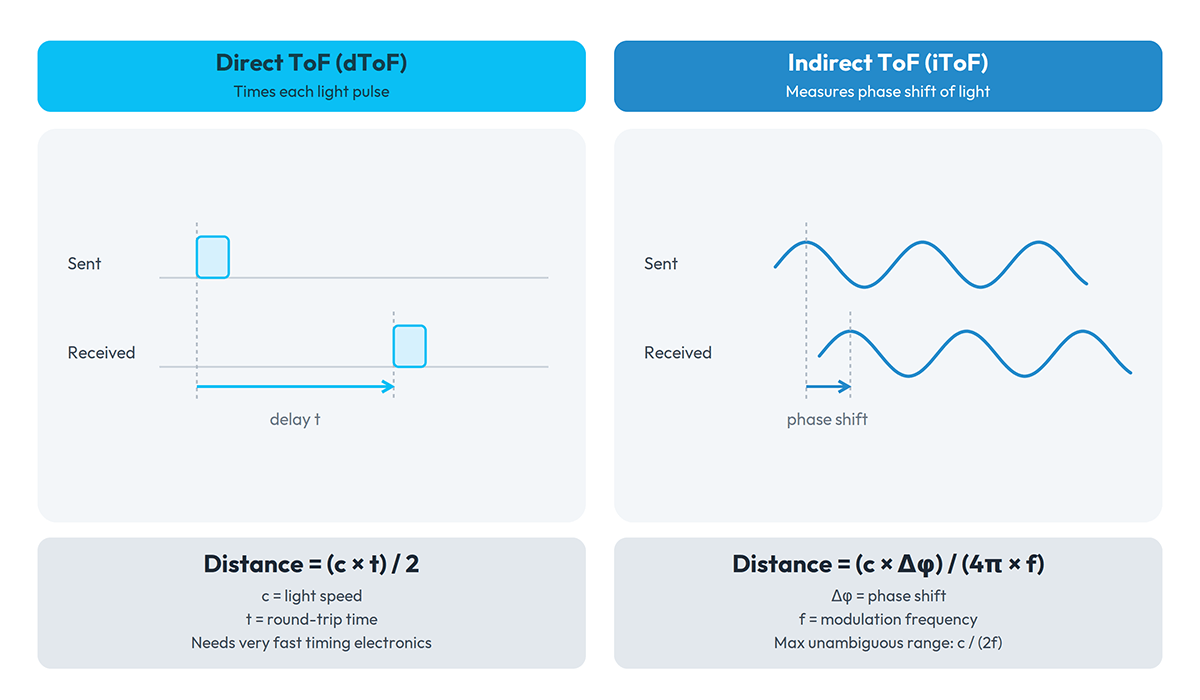
Because a ToF camera supplies its own illumination and can perform much of the depth calculation within the sensor or camera module, it can reduce the processing required on the host system.
How Does a Stereo Camera Calculate Depth?
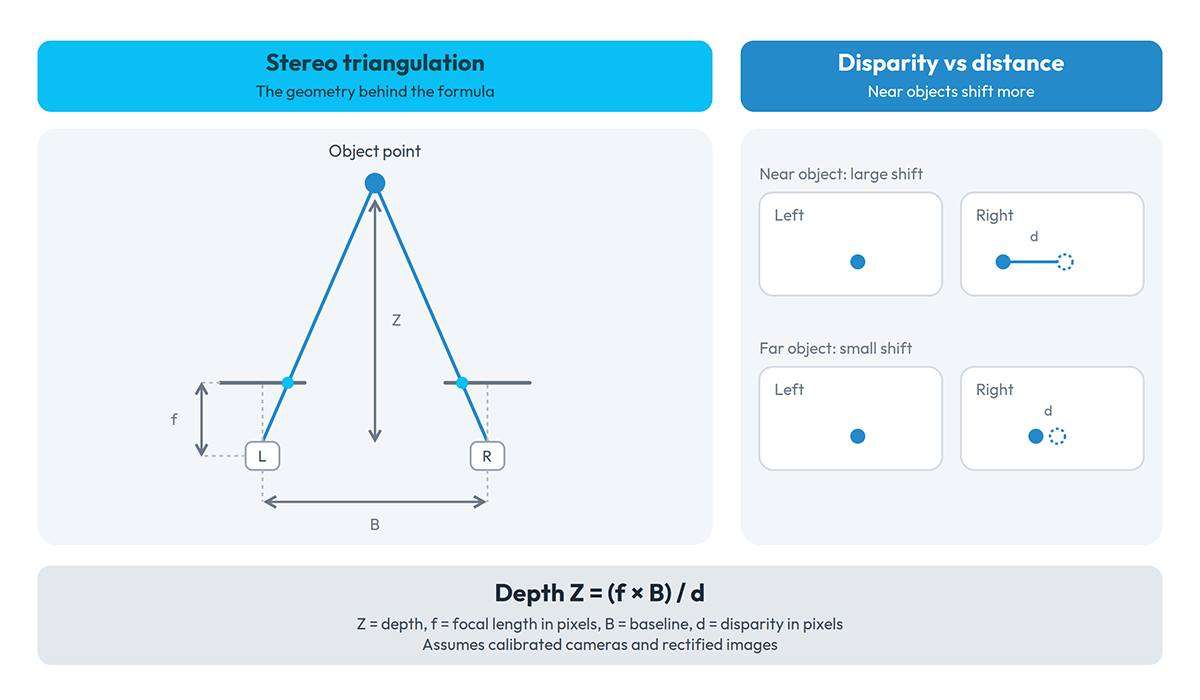
A stereo camera works much like human vision. Two cameras are mounted a fixed distance apart, known as the baseline. Each camera sees the same scene from a slightly different position, so an object appears at slightly different horizontal positions in the two images. This shift is called disparity, and it is generally larger for closer objects.
ToF vs Stereo Camera: Side-by-Side Comparison
| Factor | ToF camera | Stereo camera |
| Depth method | Active: measures emitted infrared light using time-of-flight (pulse or phase) | Triangulation from two images, usually passive |
| Sunlight outdoors | Ambient infrared can compete with the emitter and reduce range and accuracy | Sunlight does not directly interfere with depth, but can affect image quality and matching |
| Low light or night | Works well because it provides its own illumination | Depends on sensor sensitivity and available light |
| Effective range | Often limited by emitter power, sensitivity, and target reflectivity | Depends on baseline, resolution, lens, and image quality |
| Depth error vs distance | Noise generally increases as the returned signal weakens | Depth uncertainty generally increases rapidly with distance |
| Low-texture surfaces (blank wall, fresh snow) | Not dependent on visual texture | More difficult because matching relies on image features |
| Reflective or transparent surfaces | Can cause incorrect or missing depth | Can also confuse stereo matching |
| Power | Can reduce host processing when depth is processed in-camera | Typically requires stereo matching on a processor, GPU, or FPGA |
| Multiple units nearby | Can interfere unless mitigated | Passive stereo generally does not interfere |
Does Sunlight Affect ToF and Stereo Cameras Outdoors?
Sunlight is the biggest outdoor test for ToF. It contains strong infrared energy, and a ToF camera must separate its own returning light from this ambient background. As sunlight increases, the signal-to-noise ratio drops, and depth becomes noisier or incomplete. The effect grows with distance, because the light returning from the emitter weakens roughly with the square of the distance while sunlight stays about the same.
Designers have ways to reduce the problem: narrowband optical filters, higher-power emitters, shorter pulses, and wavelengths where less sunlight reaches the ground, such as around 940 nm. These help, but they add cost and power draw, and performance in direct sun depends on the specific sensor. Many ToF modules are specified mainly for indoor or shaded use, so always check the outdoor rating.
A stereo camera does not compete with the sun, and daylight usually gives it plenty of image detail. Its outdoor challenge is contrast: bright sky and deep shadow in the same frame can lose detail at both ends, and glare can hide features. That is why a high dynamic range (HDR) sensor, good exposure control, and a quality image pipeline matter so much for outdoor stereo.
Range and Accuracy: How Each Technology Scales
ToF range is limited by how much light the emitter can safely and efficiently send out. Beyond a certain distance the returned signal is too weak, and outdoors the sun reduces that distance further. ToF is less tied to geometry than stereo, but its noise still rises as the signal weakens.
Stereo range is shaped by the baseline, lens, and sensor resolution. A wider baseline and higher resolution extend useful range. However, for a given matching error, depth error grows roughly with the square of distance (ΔZ ≈ Z² × Δd / (f × B)), because an object twice as far away produces half the disparity.
The baseline involves a trade-off. A wider baseline improves depth precision at long range, but it makes the camera larger and increases the minimum sensing distance, because the two views overlap less for nearby objects. A shorter baseline is generally better suited to closer range.
How to Choose Between ToF and Stereo for an Outdoor Robot
Start with the operating environment, then speed and range. A robot that works indoors or in shaded, controlled areas at close range can use ToF effectively. A robot that works outdoors in variable daylight, at walking speed or faster, over multi-meter ranges, is often better served by stereo.
Some outdoor robots use both: ToF or ultrasonic sensors for close-range obstacle detection near the robot body, and stereo as the main forward-facing sensor for path planning and object detection at distance. This layered approach matches each sensor to the range and lighting where it performs best.
A quick checklist:
1. How far must the robot see, and how accurate must depth be at that distance?
2. How fast does the robot move, and what stopping distance does that require?
3. What lighting will it face: full sun, shade, night, or all three?
4. Which weather and dust conditions must it handle?
5. Do you need a color image alongside depth for AI perception?
6. Will several robots operate in the same space?
7. What compute and power budget does the platform allow?
oToBrite GMSL™ 3D Stereo Camera Options for Outdoor Robotics
Stereo gives outdoor robots long-range depth and visual information from the same system, but reliable performance depends on precise alignment, synchronized capture, and good image quality in challenging lighting. oToBrite's GMSL™ 3D stereo cameras are designed with these requirements in mind, offering two baseline options to match different applications.
Key features
- Two baselines: 120mm for long-range depth, and 60mm for closer-range work
- 3MP global shutter IMX900 sensor, mono or color
- GMSL™ interface: High-speed, low-latency video transmission with EMI/EMC robustness for reliable system integration
- 120dB dynamic range to keep detail in both shadows and highlights in high-contrast scenes
- Sub-microsecond (<1µs) hardware synchronization between the left and right images
- Factory pre-calibration with intrinsic and extrinsic parameters provided out of the box, plus 5-axis Active Alignment for precise optical parallelism
- Compact, rugged IP69K-rated housing with automotive-grade vibration and shock reliability
Check out more detailed information about stereo cameras below:
Conclusion
For outdoor robots, the choice between ToF and stereo comes down to sunlight, range, weather, and compute. ToF offers simple, low-compute depth that suits short range and plain surfaces. Stereo works from ambient light, can be designed for longer range, and gives an image along with depth, which is why it is often the preferred outdoor fit. Start from your robot's speed, environment, and perception needs, and test in real conditions before you commit.
Planning an outdoor robot or industrial vehicle? Contact oToBrite's sales team to discuss which baseline fits your application.
Frequently Asked Questions
Is ToF or stereo better for outdoor robots?
Stereo is often a strong choice outdoors because it uses ambient light and can be designed for longer-range sensing. ToF works well for short-range tasks and controlled or shaded lighting.
Does ToF work in direct sunlight?
It can, depending on the sensor and camera design. Optical filtering, stronger emitters, and suitable wavelengths can help, but strong sunlight can add noise and reduce usable range.
Why do outdoor robots use stereo cameras?
Stereo does not rely on an active emitter, its useful range can be extended through baseline and resolution, and it provides visual image data alongside depth. These traits suit changing outdoor conditions.
How far can a stereo camera see?
It depends on the baseline, resolution, lens, and image quality. Wider baselines and higher resolution can extend useful range, though depth accuracy decreases with distance. oToBrite stereo cameras with 60 mm and 120 mm baselines can support depth perception from 0.15m to 20m.
What stereo camera baseline should I choose?
A shorter baseline generally suits closer-range sensing, while a longer baseline improves depth precision at greater distances. Choose based on the required detection range and available mounting space.
Can a robot use ToF and stereo together?
Yes. ToF can provide near-field depth while stereo covers longer-range perception and visual information, at the cost of additional hardware and sensor-fusion work.